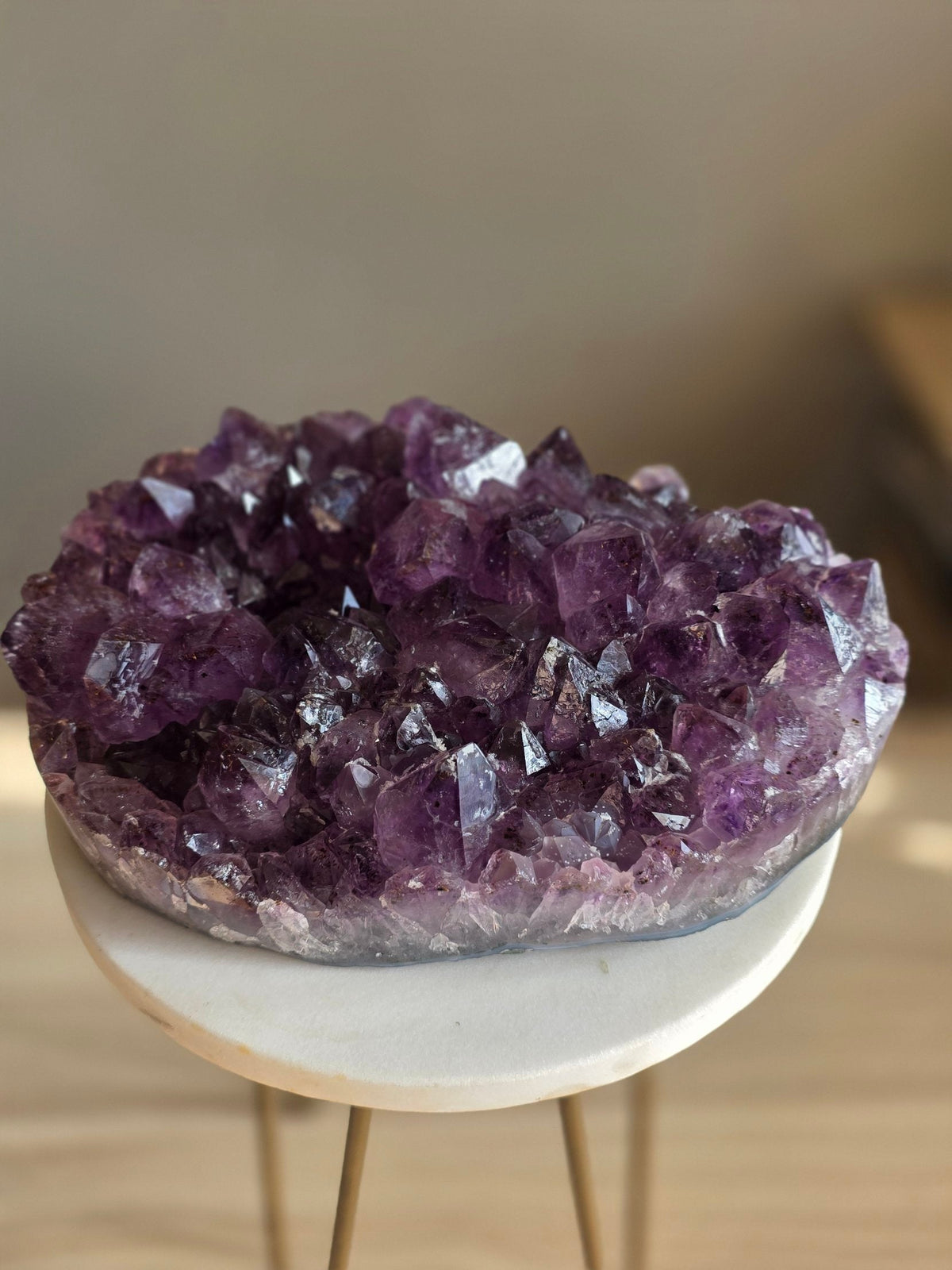
Amethyst is one of the most loved crystals in the world, but few people know the remarkable story behind it. Here is where amethyst comes from, how it formed inside ancient lava over 130 million years, and what it has meant to people from ancient Greece to modern crystal lovers.
Watch: the story of amethyst in under 3 minutes
Watch where amethyst comes from on TikTok
Where is amethyst found?
Amethyst is found on almost every continent, with notable deposits in Zambia, Madagascar, Mexico, Bolivia, Canada and Russia's Ural Mountains. But the largest deposits on Earth are in South America, and most of the amethyst sold today comes from southern Brazil and neighbouring Uruguay.
Ametista do Sul, Brazil's amethyst heartland
In the Brazilian state of Rio Grande do Sul sits a small town called Ametista do Sul, meaning "amethyst of the south". Beneath its green hills lies one of the richest amethyst deposits ever found. Miners tunnel deep into layers of ancient volcanic rock looking for hollow pockets, and when they break through they find geodes lined with sparkling purple crystals, still sitting exactly where they formed.
Some of these geodes are enormous. One Brazilian geode on display in a museum stands about 2.45 metres tall and weighs around 2.5 tonnes. Across the border, the Artigas region of northern Uruguay is famous for smaller geodes with an especially deep, dark purple colour.
How does amethyst form?
The amethyst geodes of Brazil and Uruguay grew inside some of the largest lava flows in Earth's history. It happened in four stages:
- Lava floods the land (about 130 million years ago). As South America and Africa began to split apart, vast floods of lava poured across the region, building up layer after layer of basalt rock. Geologists call these the Paraná–Etendeka flood basalts.
- Gas bubbles leave hollow pockets. As the lava cooled, gas trapped inside formed bubbles, leaving hollow cavities frozen into the solid rock.
- Silica-rich water seeps in. Over time, warm water carrying dissolved silica moved through the rock and into these hollows, first lining the walls with thin bands of agate.
- Quartz crystals grow inwards. Slowly, point by point, quartz crystals grew from the walls towards the centre of each cavity, creating the glittering interior of a geode.
What gives amethyst its purple colour?
Amethyst is a variety of quartz, and pure quartz is clear. Amethyst's purple comes from tiny traces of iron in the crystal, changed by natural radiation from the surrounding rock. Heat amethyst and the purple turns yellow or golden, which is how much of the citrine on sale today is made. It is also why amethyst should be kept out of strong, prolonged sunlight, which can slowly fade its colour.
Amethyst meaning and history
Amethyst has always been linked with a calm, clear mind. Its name comes from the ancient Greek amethystos, meaning "not drunk", and for centuries it was worn and carved into rings and seals as a stone of sobriety and self-control. Today it is also the birthstone for February.
Amethyst and the chakras
In crystal tradition, amethyst is linked with two of the body's seven chakras:
- The third eye chakra, between the eyebrows, associated with intuition, insight and inner wisdom.
- The crown chakra, at the top of the head, associated with spiritual connection and a deep sense of peace.
Browse crystals traditionally chosen for these intentions in our intuition & spiritual connection collection.
How people use amethyst
- Meditation: amethyst is one of the most popular crystals to hold or keep nearby while meditating.
- Sleep: many people keep a piece by the bed for restful sleep and calmer dreams.
- A calm mind: a small cluster or point can be held to help quiet a busy mind.
- A focal point at home: a large amethyst geode or cathedral makes a striking centrepiece in a living room, hallway or meditation corner.
New to crystals? Read our beginner's guide to crystal energy healing and the story of the history of crystal healing.
Tradition, not science
The meanings above come from long-standing crystal tradition rather than scientific evidence, and crystals are not a substitute for medical care. But whether you love amethyst for its energy or its beauty, every piece is a little part of Earth's history, around 130 million years in the making.
Find your amethyst
Every piece in our shop is a natural, one-of-a-kind crystal, photographed individually and listed with its exact size and weight. Explore our amethyst collection and amethyst geodes, read how to choose an amethyst geode, or book a private viewing at our showroom in Hove, near Brighton. UK delivery is free on orders of £100 or more.
Video images: Statement Crystals; Wikimedia Commons, including photographs by Leandro Kibisz (CC BY-SA 4.0), 7iago1990 (CC BY-SA 4.0), AmberLocket (CC0), Miguel Calvo (CC BY 4.0), James St. John (CC BY 2.0), Marie-Lan Taÿ Pamart (CC BY 4.0) and Ra'ike (CC BY 2.5); The Metropolitan Museum of Art (Open Access).